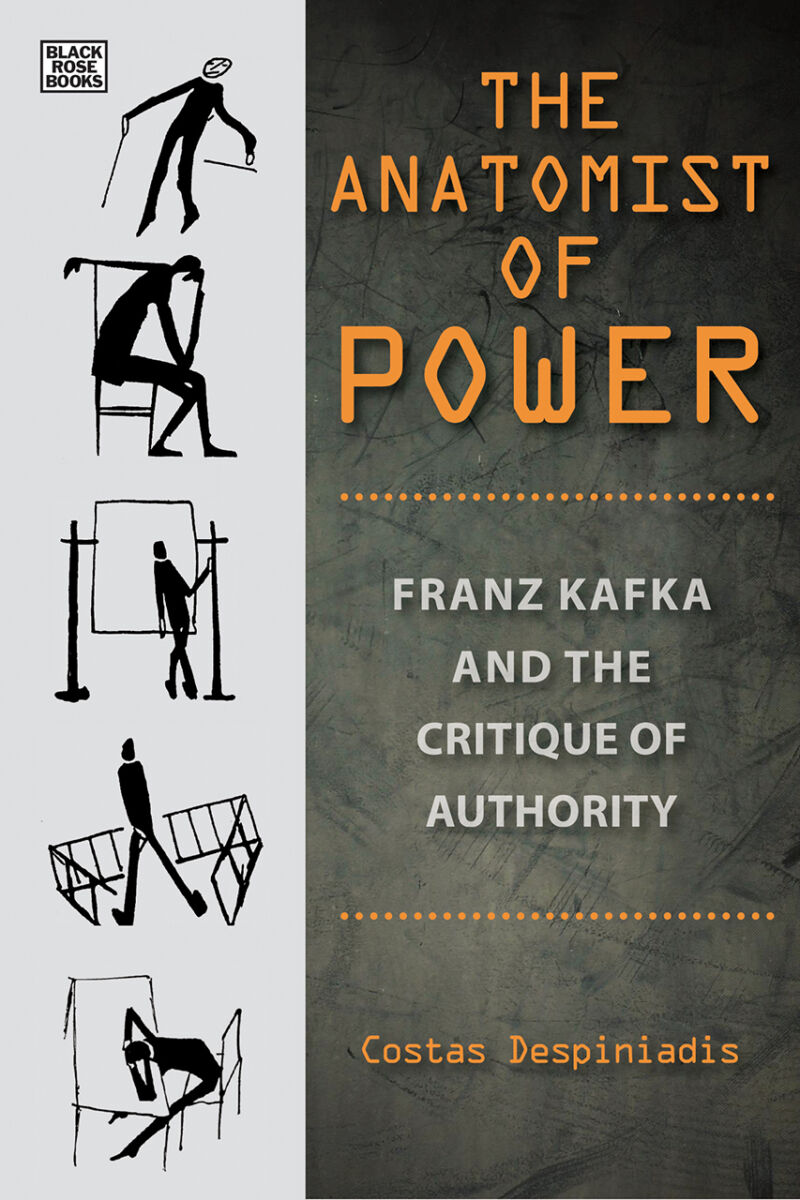
Few twentieth-century writers remain as potent as Franz Kafka—one of the rare figures to maintain both a major presence in the academy and on the shelves of general readers. Yet, remarkably, no work has yet fully focused on his politics and anti-authoritarian sensibilities. The Anatomist of Power: Franz Kafka and the Critique of Authority is a fascinating new look at his widely known novels and stories (including The Trial, Metamorphosis, In the Penal Colony and Amerika), portraying him as a powerful critic of authority, bureaucracy, capitalism, law, patriarchy, and prisons. Making deft use of Kafka’s diaries, his friends’ memoirs, and his original sketches, Costas Despiniadis addresses his active participation in Prague’s anarchist circles, his wide interest in anarchist authors, his skepticism about the Russian Revolution, and his ambivalent relationship with utopian Zionism. The portrait of Kafka that emerges is striking and fresh—rife with insights and a refusal to accept the structures of power that dominated his society.
–
Table of Contents
Introduction
The Faces of Faceless Power: The Trial, The Castle and beyond
Writing the Law on the Punished Body: In the Penal Colony
Romantic Anti-Capitalism: America
The Power of the Raging Patriarch: Metamorphosis
The Castle’s Solid Foundations: The Burrow (Der Bau)
Kafka and the Anarchists
Conclusion
–
In his compelling study Costas Despiniadis discusses Kafka as a political writer, applying to the author’s life and work the lens of anarchist criticism. In consideration of Kafka’s affinity for anarchist ideas and his affiliations with anarchists in Prague, Despiniadis interprets the nonconformism of protagonists such as Samsa, K., and Josef K. and their radical resistance against power structures and authority figures as a justified, even heroic struggle. In disagreement with the familiar approaches to Kafka, including Freudian, Lacanian, Marxist, and metaphysical ones, Despiniadis rejects any attribution of guilt or moral failure to the Kafkaen hero but instead validates the latter’s perceptions of systemic corruption. Despiniadis’s eye-opening analysis leads into uncharted territory and sets a high bar for future Kafka scholarship.
— Dagmar Lorenz, University of Illinois at Chicago, Vice President of the Kafka Society of America
This book is a rare event: a political — in the noblest meaning of the word — interpretation of Kafka’s writings. Even better, it is an anarchist reading, against the grain of the conformist academic prose on the author of The Trial. Despiniadis brings together, with admirable talent, literature, philosophy, and contemporary revolutionary issues.
— Michael Löwy, author of Franz Kafka: Subversive Dreamer